Entertainment
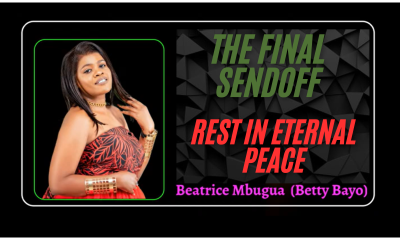
VIDEO: Betty Bayo Funeral Arrangements Underway: Family to Announce Burial Date Soon


Gospel music fans in Kenya and beyond are preparing to pay tribute to one of the industry’s most luminous voices. Beloved gospel artist Betty Bayo passed away on Monday, November 10, 2025, after a brief but fierce battle with leukaemia. allAfrica.com+2The Star+2
Her passing has left a deep void in Kenya’s gospel community and the planning for her funeral is now in motion.
Body Moved to Mortuary
Following her death at the Kenyatta National Hospital (KNH) in Nairobi, Betty’s body was transferred to the mortuary at Kenyatta University Teaching, Referral and Research Hospital (KU‑Referral). allAfrica.com+1
The move signals the start of official funeral arrangements and gives family time to prepare a fitting farewell for the late artist.
Family and Friends Convene
Sources say that family and friends have begun meeting at Betty’s home near Ngarariga Primary School. facebook.com+1
Meetings have also been held at a local hotel on Thika Road, where her ministry partners gathered to coordinate the memorial service. Instagram
These gatherings reflect the broad respect she earned — from her local community to fellow musicians.
Funeral Date and Venue Still Pending
While the memorial service has been referenced in discussions, the family has not yet announced an official date and venue for the burial. Media reports indicate that the full funeral programme will be published once finalised. The Star+1
Fans and colleagues are being asked to wait for the formal statement from the family, expected soon.
Legacy and Final Moments
Betty Bayo rose to national prominence thanks to her powerful anthem “Eleventh Hour”, which resonated with stories of hope, redemption and divine timing. allAfrica.com+1
She had also just been planning a birthday getaway with her son — plans cut short by her sudden illness. The Star
Her life and ministry have been widely celebrated for blending authentic personal testimony with worship, making her a voice for the under‑heard and the hopeful.
What’s Next
The public is invited to await the official funeral announcement.
Ministry partners and fans are encouraged to prepare tributes for the memorial service once date/time is published.
Fans can post messages of condolence and shared memories on social media using #BettyBayoLegacy





News
Fred Machoka Breaks Silence Over Golden Jubilee Rhumba Concert Drama Involving His Niece, Gloria Owoba

Veteran Kenyan broadcaster Fred Machoka has expressed gratitude following his Golden Jubilee Rhumba concert, reflecting on the concerns that surrounded the event before it brought together celebrated musicians from Kenya and the Democratic Republic of Congo.
The landmark celebration attracted Rhumba enthusiasts eager to watch established performers, including Congolese music star Koffi Olomide, legendary singer Mbilia Bel, Them Mushrooms and Les Wanyika.
However, the concert also generated online discussion following separate incidents involving Koffi Olomide and former nominated senator Gloria Orwoba, drawing attention away from some of the evening’s musical highlights.
In a post-event message cited by TUKO.co.ke, Machoka opened up about the uncertainty the organising team faced before the concert, including concerns about weather conditions and fears that an Ebola-related scare might affect attendance.
Despite those worries, the veteran broadcaster expressed relief that the event went ahead as planned.
Fred Machoka reflects on concerns before the concert
Machoka said the organising team had been anxious about whether external circumstances would disrupt the celebrations, particularly the possibility of rain affecting the event.
He also recalled concerns about whether Ebola-related fears might discourage people from attending.
In his post, Machoka credited God for helping the organisers overcome their worries and deliver the celebration.
His remarks offered a glimpse into the pressures associated with organising a major live music event featuring internationally recognised performers and a large audience.
The broadcaster also thanked fans who turned up to support the concert, praising their enthusiasm and the reception given to the musicians.
Koffi Olomide delivers an extended performance
Koffi Olomide was among the evening’s headline performers, with Machoka praising the Congolese star for entertaining fans during an extended set.
According to the remarks quoted by TUKO.co.ke, Koffi performed for approximately two hours, while his wife, Cindy Le Cœur, and other musicians also contributed to the programme.
Mbilia Bel, Them Mushrooms and Les Wanyika were among the established acts associated with the concert, which celebrated the enduring popularity of Rhumba music across East Africa.
The event highlighted the genre’s continued appeal among audiences who appreciate its distinctive guitar arrangements, harmonies and dance rhythms.
Machoka also recognised the contribution of the event’s presenters and hosts, including Jeff Koinange, Mwalimu Churchill, Eric Latiff, Dee and Patrick Igunza.
He thanked those involved in making the programme possible and indicated that another edition could be considered in the future.
Gloria Orwoba incident draws attention
Despite the music performances, the event attracted controversy after former nominated senator Gloria Orwoba reportedly encountered a difficult moment on stage.
TUKO.co.ke reported that Orwoba was asked to leave the stage amid chants from some members of the audience.
The incident generated discussion online, with attention also directed at her relationship with Machoka, who is her uncle.
However, the circumstances surrounding the exchange and the motivations of individual audience members should not be assumed beyond what can be established from verified footage and accounts.
The episode added a political dimension to an event primarily organised to celebrate music and Machoka’s milestone.
Disagreement involving Koffi Olomide also discussed
A separate incident involving Machoka and Koffi Olomide also attracted attention after footage and accounts of an apparent disagreement circulated on social media.
The exchange became another talking point following the concert, prompting discussion about what had happened between the veteran broadcaster and the Congolese musician.
The available account does not, on its own, establish the full circumstances of the disagreement or either man’s complete perspective on the incident.
Further details should therefore be attributed to verified footage or direct statements from the individuals involved rather than speculation.
Machoka focuses on gratitude and the possibility of another concert
Despite the controversies, Machoka’s post-event message emphasised appreciation for the fans, musicians, presenters and other people who contributed to the celebration.
His remarks suggested that he regarded the event as an important milestone, notwithstanding the challenges and public discussion surrounding it.
He also left open the possibility of organising another edition, while acknowledging that a repeat event was not guaranteed.
The Golden Jubilee celebration brought together generations of Rhumba performers and audiences, underlining the genre’s lasting place in Kenya’s entertainment scene.
For Machoka, the response from music lovers appeared to be a central part of the experience, even as the incidents involving Orwoba and Koffi continued to generate debate after the final performances.

Veteran Indian actor and filmmaker Nana Patekar, celebrated for his commanding performances, distinctive dialogue delivery and remarkable versatility, has died at the age of 75, leaving behind a legacy that stretches from Indian cinema and theatre to humanitarian work among struggling farming communities.
Patekar died on Thursday, October 8, 2026, at his home in Goa after suffering a suspected cardiac arrest, according to the Associated Press. His son, Malhar Patekar, confirmed his death.
Over nearly five decades, Patekar established himself as one of the distinctive performers in Hindi and Marathi cinema, moving between hard-hitting dramas, character-driven films and mainstream comedy. His career earned him three National Film Awards and the Padma Shri, one of India’s highest civilian honours.
Yet, beyond the memorable characters he portrayed on screen, the actor also devoted considerable effort to supporting rural communities affected by drought, water shortages and agricultural hardship.
From theatre beginnings to a celebrated film career
Born in Maharashtra in 1951, Patekar developed his craft through theatre before entering the film industry. He made his Hindi film debut in Gaman in 1978 and gradually built a reputation for portraying complicated characters with an intensity that set him apart.
According to the Associated Press, his career bridged mainstream Bollywood and India’s parallel cinema movement, which placed greater emphasis on realism and social issues.
One of his significant early performances came in Ankush (1986), which helped raise his profile as an actor capable of bringing emotional depth to socially grounded stories.

His international recognition grew following his appearance in Mira Nair’s Salaam Bombay! (1988), a film that received an Academy Award nomination for Best Foreign Language Film.
Patekar subsequently delivered one of his most acclaimed performances in Parinda (1989), playing the ruthless underworld figure Anna Seth. The role earned him the National Film Award for Best Supporting Actor and cemented his reputation for portraying menacing, psychologically complex characters.
In Krantiveer (1994), he demonstrated another dimension of his acting, playing Pratap, a man who confronts corruption and injustice. His performance earned him the National Film Award for Best Actor.
The National Film Awards’ official citation praised his portrayal for revealing the strength that ordinary people can summon when pushed to their limits.
His ability to move between intense drama and more accessible commercial cinema became a defining feature of his career.
A performer who refused to be confined to one genre
Patekar’s filmography reflected an actor comfortable taking on vastly different personalities, from dangerous criminals and determined police officers to emotionally vulnerable family men.
In Khamoshi: The Musical (1996), directed by Sanjay Leela Bhansali, he portrayed a hearing- and speech-impaired father whose relationship with his daughter forms an emotional centre of the story.
He earned another National Film Award for Best Supporting Actor for Agni Sakshi (1996), in which he played a possessive and abusive husband.
His later performances continued to demonstrate his range. In Ab Tak Chhappan (2004), he portrayed a tough Mumbai police encounter specialist, while Apaharan (2005) explored the world of kidnapping and political corruption.
Patekar also appeared in Prakash Jha’s political drama Raajneeti (2010) and played real-life doctor and social activist Prakash Amte in the Marathi film Dr. Prakash Baba Amte: The Real Hero (2014).
In the Marathi film Natsamrat (2016), he took on the role of Ganpatrao Belwalkar, a celebrated theatre actor struggling with the realities of ageing and life after retirement. The performance brought his theatrical roots into focus and introduced his dramatic abilities to another generation of viewers.
He later played the antagonist Hari Dada opposite Rajinikanth in Kaala (2018).
These performances illustrate the breadth of his career, which encompassed commercial entertainers, serious social dramas, adaptations and films inspired by real people.
The comic side that won a new generation of fans
Although Patekar became widely respected for his intense dramatic roles, he also found a different audience through mainstream comedy.
His portrayal of Uday Shetty, a gangster with a volatile temper and an unexpectedly humorous side, in Welcome (2007) introduced him to many viewers through a lighter form of storytelling.
The character’s attempts to control his anger, often expressed through the memorable phrase “Control Uday, control!”, became a popular part of Indian internet culture.
Scenes and facial expressions from Patekar’s films subsequently circulated widely as memes and reaction images on social media. His expressive face and distinctive delivery allowed clips from older films to find new life among younger audiences who might not have followed his career from the beginning.
This digital popularity demonstrated how an actor whose career began long before social media could remain relevant to audiences who encountered his work through entirely different channels.
Recognition through major national awards
Patekar’s contribution to Indian cinema was recognised through several major honours.
His three National Film Awards included Best Supporting Actor for Parinda, Best Actor for Krantiveer and Best Supporting Actor for Agni Sakshi.
He also received the Padma Shri, recognising his contribution to Indian arts and entertainment.
The awards reflected his ability to excel in roles that demanded emotional intensity, physical presence and a strong understanding of complex characters.
Following his death, Prime Minister Narendra Modi paid tribute to the actor, highlighting his distinctive screen presence and versatility. As reported by the Associated Press, Modi said Patekar had created characters that audiences would remember for generations.
Beyond the camera: His work with farmers and rural communities
While his film career brought him national recognition, Patekar’s involvement in social welfare became another important part of his public life.
In September 2015, he co-founded the NAAM Foundation with fellow Marathi actor Makarand Anaspure. According to the organisation’s official website, the initiative emerged in response to severe drought conditions, water shortages and the growing distress experienced by farmers in Maharashtra.
Its work focused on longer-term solutions, including water conservation, restoring canals and abandoned water projects, improving groundwater availability and supporting rural livelihoods.
The foundation’s activities extended beyond environmental projects to practical assistance for families facing economic hardship.
A report published by The Indian Express on October 10, 2026, documented how the organisation provided sewing machines to women, supported the construction of homes for vulnerable families, assisted students from farming communities and undertook water-conservation projects in drought-prone parts of the Marathwada region.
In Beed district, the newspaper reported, river desilting and widening work covering more than 30 kilometres had benefited approximately 140 villages and around 100,000 farmers, according to the foundation’s district coordinator.
The report also highlighted assistance given to families affected by farmer suicides and crop failures, including support for children’s education and housing.
These initiatives offered a different picture of Patekar’s public life: one in which his influence was not measured solely by film credits or awards, but also by efforts to help people facing difficult circumstances.
NAAM Foundation’s work continues to represent an important part of the legacy associated with his name.
A complex public figure and an enduring screen presence
Patekar’s public life was not without controversy. In 2018, during India’s #MeToo movement, actress Tanushree Dutta accused him of sexual harassment in connection with a film production dating back to 2008. Patekar denied the allegation. The Associated Press included the controversy in its report on his life and career.
His death brings renewed attention to both his artistic achievements and the wider story of a public figure whose career unfolded across changing eras of Indian entertainment.
He worked in an industry that evolved from theatre and traditional filmmaking to large-scale commercial productions and, eventually, a digital culture in which scenes from decades-old films can reach millions of people again.
Through his roles, Patekar demonstrated a capacity to inhabit characters across the emotional spectrum, from menace and anger to vulnerability and comedy.
Funeral and tributes
Patekar’s final rites were held at his farmhouse in Donje, near Pune, on October 8, with full state honours in recognition of his contribution to Indian cinema and theatre, according to The Indian Express.
His death prompted tributes from political leaders, fellow performers and admirers who remembered his distinctive acting style and long career.
For many film enthusiasts, his legacy will remain closely associated with the powerful performances that made Parinda, Krantiveer, Salaam Bombay! and Natsamrat memorable works.
For communities reached through his charitable initiatives, however, his contribution also included efforts directed towards water security, education, housing and the livelihoods of farming families.
Nana Patekar’s life therefore tells a story that extends beyond the screen: that of an actor who earned recognition for his craft while also becoming associated with efforts to address hardship in rural India.
His passing marks the end of a career spanning nearly five decades, but his films and the social initiatives he helped establish remain important parts of his legacy.
Diaspora
VIDEO: Former Italian Catholic Priest Marries Kenyan Woman After Years of Missionary Service

Italian-born former Catholic priest Sandro Ferretto has married Sharon Jepng’ok, a Tugen woman from Baringo South, in a traditional Koito ceremony that brought together Italian and Kenyan cultures in a remarkable new chapter of his life.
For years, Sandro Ferretto was known in parts of Baringo not as a groom, but as a Catholic missionary priest who dedicated himself to serving local communities.
Now, the Italian-born former cleric has returned to the region under very different circumstances — this time as the husband of a Kenyan woman and a new member of her family.
Ferretto married Sharon Jepng’ok during a traditional ceremony held on Sunday, September 6, 2026, at Seretion Village in Kasiela, Baringo South, according to multiple Kenyan reports.
Former Italian Catholic Priest Marries Kenyan Woman After Years of Missionary Service pic.twitter.com/fWEzqbn8eH
— BMJ Muriithi (@bmjmuriithi) September 7, 2026
The ceremony, described as a Koito, brought together relatives, elders and members of the local community as the former priest embraced aspects of Tugen culture during the celebrations.
The marriage has attracted attention partly because of Ferretto’s unusual connection to the area.
Before returning to Italy, he spent years in Kenya as a missionary priest, working with communities in the Diocese of Nyahururu.
From Italy to Kenya
Ferretto’s connection to Kenya is well documented by his former diocese in Italy.
The Diocese of Padua identifies him as a fidei donum missionary who was sent to Kenya in 2007.
According to the diocese, Ferretto was born in Piove di Sacco, near Padua, Italy, in 1973. He entered the seminary in 1991 and was ordained a priest in 1999.
He later spent seven years as a parish priest in Rossano Veneto before leaving Italy for missionary service in Kenya in September 2007.
In Kenya, Ferretto served as parish priest of Mochongoi, an area within the Diocese of Nyahururu.
The Diocese of Padua’s own records describe him as one of the Padua priests serving in Kenya and specifically identify him as the parish priest of Mochongoi.
His missionary work brought him into close contact with different Kenyan communities, including the Kikuyu, Kalenjin, Tugen and Pokot peoples.
In an account published by the Diocese of Padua, Ferretto described Mochongoi as a large parish made up of dozens of local communities and spoke about efforts to promote peace and reconciliation among communities that had experienced ethnic tensions.
A missionary who became part of the community
Ferretto’s years in Kenya appear to have left a lasting impression on him.
In a message published by the Diocese of Padua after his return to Italy, he reflected emotionally on his departure from Mochongoi.
He wrote that he felt privileged to have lived in another country, experienced another culture and been welcomed by people who had taught him important lessons about hospitality, sharing and community.
His reflection ended with a striking observation: although he had been sent to Kenya to evangelize, he felt that he had also been changed by the people he encountered there.
That history makes his latest connection to Baringo particularly striking.
Years after serving the local community as a priest, Ferretto has now returned to the area as the husband of a Kenyan woman.
From the church to family life
Kenyan reports describe Ferretto as having left active priestly ministry before marrying Sharon.
The Kenya Times reported that he left the priesthood and married Sharon Jepng’ok, describing her as a Tugen woman from Baringo South. The report also placed the traditional ceremony at Seretion Village in Kasiela, an area associated with Ferretto’s previous missionary work.
However, there is an important distinction when describing his departure from the Catholic priesthood.
While current reports describe him as a former priest who left active ministry and subsequently married, there is no publicly located statement from the Vatican or the Diocese of Padua in the sources reviewed confirming the precise canonical status of his departure from the clerical state.
For that reason, it is more accurate to describe Ferretto as a former Catholic priest who left active priestly ministry rather than claim that the Vatican has formally laicized him unless an official confirmation becomes available.
The Diocese of Padua’s records confirm that Ferretto returned permanently from his Kenyan missionary assignment and was subsequently appointed parish priest in Italy in 2020.
A Tugen wedding with an Italian connection
The ceremony in Baringo was more than a marriage between two individuals.
It also brought together two very different cultural backgrounds.
Sharon’s Tugen heritage was prominently represented during the traditional ceremony, while Ferretto’s Italian background added another dimension to the celebration.
Reports say the former missionary embraced the traditional setting and participated in the cultural proceedings as he formally became part of Sharon’s family.
The result was a striking reversal of sorts.
For years, Ferretto had arrived in Kenya as an Italian Catholic missionary working among Kenyan communities.
Now, he has become a Kenyan son-in-law.
A story that comes full circle
Ferretto’s journey in Kenya began nearly two decades ago when he arrived as a missionary priest.
The Diocese of Padua records that he spent years working in Mochongoi, one of the parishes in the Nyahururu Diocese, before eventually returning to Italy.
His missionary chapter did not, however, erase his connection to Kenya.
In 2023, the Diocese of Padua still featured Ferretto speaking about his Kenyan experience, including his encounters with Kikuyu, Tugen and Pokot communities and his reflections on the effects of violence and reconciliation in the region.
Now, that long association with Kenya has taken an unexpected personal turn.
The former missionary priest has married a Kenyan woman from the very region where he once served.
For Sharon, it marks the beginning of a marriage that crosses national and cultural boundaries.
For Ferretto, it represents a dramatically different chapter from the one in which Kenyans knew him as a Catholic priest.
And for the Baringo community, the story has produced an unusual sight: an Italian former missionary returning to the community he once served, this time not wearing clerical robes, but celebrating his marriage as a Tugen son-in-law.
From missionary to husband, Sandro Ferretto’s Kenyan journey has taken a turn few could have predicted.

Federal Judge Revokes Citizenship of North Carolina Man Convicted of Child Sex Crimes

Woman Interrupts Church Wedding With Children, Claims Groom Is Her Husband

Fred Machoka Breaks Silence Over Golden Jubilee Rhumba Concert Drama Involving His Niece, Gloria Owoba

VIDEO: iPhone 17 Air Leak Reveals Ultra-Thin Design: A Bold Leap Beyond the iPhone 16 Pro

How U.S. Remittance 5% Tax Bill Could Impact Kenyan Diaspora: What You Need to Know

Motorola Launches $1,300 Razr Ultra Foldable Smartphone with AI Features, Swarovski-Enhanced Earbuds

 Tech1 year ago
VIDEO: iPhone 17 Air Leak Reveals Ultra-Thin Design: A Bold Leap Beyond the iPhone 16 Pro
- News1 year ago
How U.S. Remittance 5% Tax Bill Could Impact Kenyan Diaspora: What You Need to Know
- Tech1 year ago
Motorola Launches $1,300 Razr Ultra Foldable Smartphone with AI Features, Swarovski-Enhanced Earbuds
- Insurance Basics1 year ago
Popular Apps May Be Secretly Tracking Your Driving – And Raising Your Insurance Rates
- Tech1 year ago
Motorola Razr Ultra (2025) Launches With Free 1TB Storage Upgrade
- News1 year ago
What would you do if your Gold Digger girlfriend behaved like this?
- News1 year ago
Box Office: ‘Sinners’ Holds No. 1 Spot With $13M Friday; ‘The Accountant 2’ Debuts With $9.4M
- Insurance Basics1 year ago
Florida House Passes ‘Pam Rock Act’ Requiring Dog Registry and $100K Liability Insurance