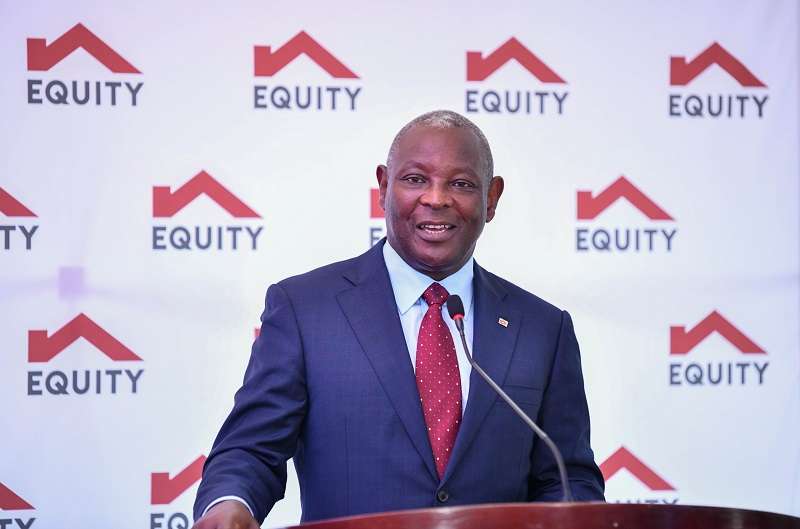
For years, African banking expansion was largely measured by branch networks, national dominance, and balance-sheet growth. Equity Group Holdings is now pushing a far more ambitious idea: scale without borders.
The Nairobi-based lender says it wants to operate in 15 countries and serve 100 million customers by 2030, a target that would place it among the most expansive financial institutions ever built on the continent. The announcement came as the group reported its strongest first-quarter performance on record, crossing the KSh 2 trillion asset threshold for the first time while posting sharp growth in profits, deposits, and regional operations.
What stands out is not simply the pace of growth. It is where that growth is increasingly coming from.
For the first time, Equity’s subsidiaries outside Kenya contributed more than half of the group’s assets and profit before tax — a symbolic milestone for a bank that built its reputation serving low-income and previously unbanked customers in Kenya before evolving into a regional financial powerhouse.
Group Managing Director and CEO Dr. James Mwangi said the lender, which currently serves 22.7 million customers across six countries, is targeting 15 countries and 100 million customers by 2030 through organic growth and acquisitions.
That strategy reflects a broader shift underway in African finance. The continent’s most aggressive banks are no longer thinking like domestic institutions with regional outposts. They are increasingly behaving like pan-African platforms competing for influence across trade corridors, mobile payments, SME lending, insurance, and digital infrastructure.
In many ways, Equity’s trajectory mirrors the evolution of African telecom giants over the past two decades — companies that expanded beyond saturated home markets into faster-growing economies with younger populations and lower banking penetration.
The Regional Bet Is Paying Off
The latest results suggest Equity’s regional diversification strategy is beginning to mature.
Operations outside Kenya now account for a majority share of the group’s business, reducing its dependence on a single economy at a time when East African markets are experiencing uneven inflation, currency pressures, and shifting interest-rate environments.
The Democratic Republic of Congo has emerged as a particularly important growth engine. Equity BCDC, the group’s Congolese subsidiary, remains its largest operation outside Kenya and continues to benefit from a vast underbanked population, strong demand for trade finance, and growing formalization within parts of the economy.
Tanzania also delivered standout growth, recording rapid expansion across loans, deposits, and profitability. That performance matters because Tanzania has historically been a difficult market for foreign banks seeking meaningful scale. Strong execution there signals Equity may be improving its ability to localize operations rather than simply replicating its Kenyan model abroad.
Uganda, meanwhile, was the lone weak spot in the quarter, highlighting a reality often overlooked in investor conversations about African banking: regional expansion can amplify risk just as easily as it amplifies opportunity.
Operating across multiple African jurisdictions means navigating different regulatory systems, currencies, tax structures, and political environments simultaneously. A slowdown in one market can quickly offset gains elsewhere.
Still, the broader direction is unmistakable. Equity is evolving from a Kenyan bank with regional subsidiaries into a regional institution with Kenyan roots.
Digital Banking Is Quietly Reshaping the Economics of Growth
One of the most consequential details in the earnings report received comparatively little public attention: nearly 90% of transactions are now happening through digital channels.
That statistic helps explain how Equity can realistically pursue 100 million customers without building thousands of expensive physical branches.
Traditional banking expansion relied heavily on brick-and-mortar infrastructure, which made continental scale extraordinarily costly. Digital banking changes the economics entirely. Customer acquisition becomes faster, operating costs decline, and services can expand into underserved markets without waiting for physical infrastructure investment.
This is especially important in Africa, where mobile penetration has dramatically outpaced traditional banking access.
According to the World Bank financial inclusion overview, digital financial services have become one of the continent’s most important tools for bringing unbanked populations into the formal economy. Kenya, in particular, has often been cited globally as a leading example of mobile-money-driven financial inclusion.
Equity’s digital lending growth also reveals another strategic advantage: data.
Banks with large digital ecosystems gain access to transaction behavior, repayment patterns, and customer activity at a scale that smaller institutions struggle to match. That data increasingly shapes credit scoring, insurance underwriting, and cross-selling opportunities.
In practical terms, the future African banking battle may not be fought primarily over branches or even deposits. It may be fought over ecosystems — who controls the customer’s daily financial activity across payments, credit, savings, insurance, and business services.
Why Investors Are Watching Asset Quality Closely
Despite the strong headline numbers, investors are unlikely to ignore one key issue: non-performing loans.
Equity’s bad loan ratio improved significantly year-on-year, but it still remains above management’s long-term target range. That matters because rapid expansion often creates pressure to grow lending aggressively, especially in frontier markets where credit information systems can be weaker.
African banks have historically struggled with balancing growth ambitions against loan-book quality. Periods of rapid expansion are often followed by painful cleanups when economic conditions tighten.
Equity appears determined to avoid that pattern. The decline in loan loss provisions and stronger IFRS coverage indicate management is prioritizing balance-sheet resilience alongside growth.
That balancing act will become increasingly important as the bank pushes deeper into higher-risk but faster-growing markets.
The wider banking sector is also operating in a more complex environment globally. Rising geopolitical uncertainty, currency volatility, and pressure on emerging-market debt are forcing lenders to rethink risk exposure across regions. Recent analysis from the International Monetary Fund financial sector analysis has warned that tighter financial conditions continue to test banking systems in developing economies.
More Than a Bank
Equity’s evolution into insurance, health coverage, and digital financial services reflects another major shift happening across African finance: the rise of the financial super-platform.
Banks increasingly want customers to remain inside a single ecosystem for everything from loans and payments to insurance and investment products. The strategy deepens customer loyalty while creating multiple revenue streams beyond traditional interest income.
That matters because banking margins are changing globally. Digital competition is compressing fees, fintech startups are targeting profitable niches, and younger consumers increasingly expect low-cost financial services delivered instantly through smartphones.
Equity’s answer appears to be scale, diversification, and ecosystem depth.
The group’s first-quarter results suggest that strategy is working — at least for now.
What happens over the next few years may determine whether Equity becomes merely East Africa’s dominant bank or one of the defining financial institutions of modern Africa.
For readers tracking the broader evolution of African banking and regional finance, the African Development Bank regularly publishes research on financial integration, digital banking, and economic growth trends across the continent.
Post Views: 5