Entertainment
When Kenyatta Beat the Drum: The Rise and Rule of Fearsome Rift Valley PC Isaiah Mathenge

By BMJ Muriithi
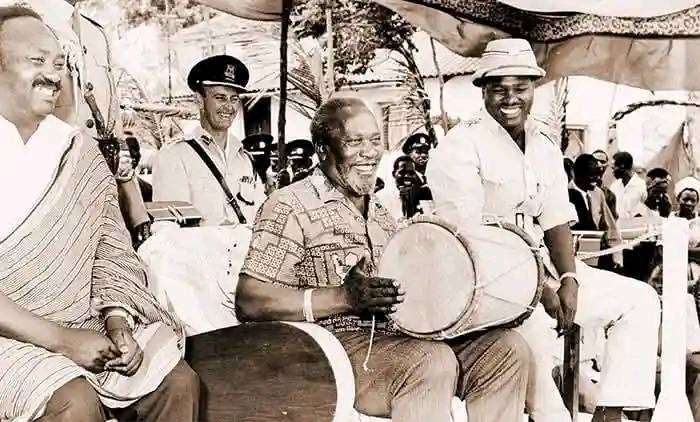
A rarely seen photograph from 1966 offers a glimpse into the lighter side of Kenya’s founding president, Jomo Kenyatta. The image shows Kenyatta enthusiastically trying out a traditional drum that had been presented to him during a visit to Mazeras, Kwale County. Standing proudly beside him are Kwale North MP Robert Matano and Coast Provincial Commissioner Isaiah Mathenge.
It was a moment of celebration and unity in the early years of independence — a time when the young nation was still shaping its identity. Yet, the smiling face of Isaiah Mathenge, then a regional administrator, would later become associated with one of the most powerful and feared provincial regimes in Kenya’s history.
From the Coast to the Rift Valley Powerhouse
In 1971, Isaiah Mathenge was transferred from the Coast Province to the Rift Valley, a region that would define his legacy. The Rift Valley was not only vast and diverse, but also politically sensitive — the heartland of national politics and a crucial power base for the Kenyatta government.
There, Mathenge governed with firm control and unyielding authority. He quickly established himself as a loyal servant of the state, earning both praise and criticism for his unwavering commitment to enforcing government directives. His leadership style reflected the firm hand of the Kenyatta era — decisive, centralized, and intolerant of opposition.
Even Vice President Daniel arap Moi, who would later ascend to the presidency, is said to have been cautious in navigating the power structure Mathenge commanded within the region.
A Reputation Built on Loyalty and Fear
Mathenge’s rule in the Rift Valley was marked by his direct and sometimes intimidating approach to governance. Tales of his no-nonsense methods still circulate in political circles to this day.
One of his most memorable confrontations was with Butere MP Martin Shikuku, a fierce critic of the government. In one heated moment, Mathenge reportedly warned that he would personally discipline Shikuku if he dared set foot in Nakuru.
Another dramatic clash came with Nakuru Town MP Mark Mwithaga, who accused Mathenge of behaving like a colonial-era governor. Shortly afterward, Mwithaga found himself arrested over a domestic matter — a move that many observers at the time believed was politically motivated. Whether true or not, such incidents cemented Mathenge’s reputation as a man who ruled with absolute control.
The Circle of Kenyatta Loyalists
Isaiah Mathenge did not act alone. He was part of a powerful network of senior officials and politicians who were fiercely loyal to President Kenyatta.
This group included Provincial Police Chief James Mungai, Nakuru Mayor Mburu Gichua, Provincial Engineer Kim Gatende, Kenyatta’s Security Chief Wanyoike Thungu, and Nakuru North MP Kihika Kimani. Together, they formed a formidable bloc that maintained order and ensured unwavering support for the president’s administration across the Rift Valley and Central Kenya.
Their influence extended far beyond administrative duties. They shaped the political tone of the decade, ensuring that any form of dissent — real or perceived — was swiftly addressed.
A Complex Legacy
To some, Isaiah Mathenge was the embodiment of discipline, loyalty, and administrative efficiency. To others, he represented the excesses of provincial authority that characterized Kenya’s early years after independence.
Regardless of one’s perspective, Mathenge’s name continues to surface whenever the history of Kenya’s provincial administration is discussed. His story reflects a time when provincial commissioners were among the most powerful individuals in government — often holding more sway than elected leaders at the local level.
From that cheerful day in Mazeras, when Kenyatta beat the drum, to the tense years that followed in Nakuru and beyond, Mathenge’s journey mirrors the evolution of Kenya’s political system — from idealism to consolidation of power.
Historical Reflection
Isaiah Mathenge’s career is a window into the complexities of leadership during Kenya’s formative years. His methods were tough, sometimes controversial, but undeniably effective in maintaining stability at a time when the country was still finding its footing.
The photograph of Kenyatta, Matano, and Mathenge remains an enduring symbol of that era — a moment when culture, authority, and politics intersected. It reminds Kenyans that the foundations of today’s governance were built by men and women who operated in challenging times, balancing loyalty to the state with the demand for national unity.




Diaspora
VIDEO: Former Italian Catholic Priest Marries Kenyan Woman After Years of Missionary Service

Italian-born former Catholic priest Sandro Ferretto has married Sharon Jepng’ok, a Tugen woman from Baringo South, in a traditional Koito ceremony that brought together Italian and Kenyan cultures in a remarkable new chapter of his life.
For years, Sandro Ferretto was known in parts of Baringo not as a groom, but as a Catholic missionary priest who dedicated himself to serving local communities.
Now, the Italian-born former cleric has returned to the region under very different circumstances — this time as the husband of a Kenyan woman and a new member of her family.
Ferretto married Sharon Jepng’ok during a traditional ceremony held on Sunday, September 6, 2026, at Seretion Village in Kasiela, Baringo South, according to multiple Kenyan reports.
Former Italian Catholic Priest Marries Kenyan Woman After Years of Missionary Service pic.twitter.com/fWEzqbn8eH
— BMJ Muriithi (@bmjmuriithi) September 7, 2026
The ceremony, described as a Koito, brought together relatives, elders and members of the local community as the former priest embraced aspects of Tugen culture during the celebrations.
The marriage has attracted attention partly because of Ferretto’s unusual connection to the area.
Before returning to Italy, he spent years in Kenya as a missionary priest, working with communities in the Diocese of Nyahururu.
From Italy to Kenya
Ferretto’s connection to Kenya is well documented by his former diocese in Italy.
The Diocese of Padua identifies him as a fidei donum missionary who was sent to Kenya in 2007.
According to the diocese, Ferretto was born in Piove di Sacco, near Padua, Italy, in 1973. He entered the seminary in 1991 and was ordained a priest in 1999.
He later spent seven years as a parish priest in Rossano Veneto before leaving Italy for missionary service in Kenya in September 2007.
In Kenya, Ferretto served as parish priest of Mochongoi, an area within the Diocese of Nyahururu.
The Diocese of Padua’s own records describe him as one of the Padua priests serving in Kenya and specifically identify him as the parish priest of Mochongoi.
His missionary work brought him into close contact with different Kenyan communities, including the Kikuyu, Kalenjin, Tugen and Pokot peoples.
In an account published by the Diocese of Padua, Ferretto described Mochongoi as a large parish made up of dozens of local communities and spoke about efforts to promote peace and reconciliation among communities that had experienced ethnic tensions.
A missionary who became part of the community
Ferretto’s years in Kenya appear to have left a lasting impression on him.
In a message published by the Diocese of Padua after his return to Italy, he reflected emotionally on his departure from Mochongoi.
He wrote that he felt privileged to have lived in another country, experienced another culture and been welcomed by people who had taught him important lessons about hospitality, sharing and community.
His reflection ended with a striking observation: although he had been sent to Kenya to evangelize, he felt that he had also been changed by the people he encountered there.
That history makes his latest connection to Baringo particularly striking.
Years after serving the local community as a priest, Ferretto has now returned to the area as the husband of a Kenyan woman.
From the church to family life
Kenyan reports describe Ferretto as having left active priestly ministry before marrying Sharon.
The Kenya Times reported that he left the priesthood and married Sharon Jepng’ok, describing her as a Tugen woman from Baringo South. The report also placed the traditional ceremony at Seretion Village in Kasiela, an area associated with Ferretto’s previous missionary work.
However, there is an important distinction when describing his departure from the Catholic priesthood.
While current reports describe him as a former priest who left active ministry and subsequently married, there is no publicly located statement from the Vatican or the Diocese of Padua in the sources reviewed confirming the precise canonical status of his departure from the clerical state.
For that reason, it is more accurate to describe Ferretto as a former Catholic priest who left active priestly ministry rather than claim that the Vatican has formally laicized him unless an official confirmation becomes available.
The Diocese of Padua’s records confirm that Ferretto returned permanently from his Kenyan missionary assignment and was subsequently appointed parish priest in Italy in 2020.
A Tugen wedding with an Italian connection
The ceremony in Baringo was more than a marriage between two individuals.
It also brought together two very different cultural backgrounds.
Sharon’s Tugen heritage was prominently represented during the traditional ceremony, while Ferretto’s Italian background added another dimension to the celebration.
Reports say the former missionary embraced the traditional setting and participated in the cultural proceedings as he formally became part of Sharon’s family.
The result was a striking reversal of sorts.
For years, Ferretto had arrived in Kenya as an Italian Catholic missionary working among Kenyan communities.
Now, he has become a Kenyan son-in-law.
A story that comes full circle
Ferretto’s journey in Kenya began nearly two decades ago when he arrived as a missionary priest.
The Diocese of Padua records that he spent years working in Mochongoi, one of the parishes in the Nyahururu Diocese, before eventually returning to Italy.
His missionary chapter did not, however, erase his connection to Kenya.
In 2023, the Diocese of Padua still featured Ferretto speaking about his Kenyan experience, including his encounters with Kikuyu, Tugen and Pokot communities and his reflections on the effects of violence and reconciliation in the region.
Now, that long association with Kenya has taken an unexpected personal turn.
The former missionary priest has married a Kenyan woman from the very region where he once served.
For Sharon, it marks the beginning of a marriage that crosses national and cultural boundaries.
For Ferretto, it represents a dramatically different chapter from the one in which Kenyans knew him as a Catholic priest.
And for the Baringo community, the story has produced an unusual sight: an Italian former missionary returning to the community he once served, this time not wearing clerical robes, but celebrating his marriage as a Tugen son-in-law.
From missionary to husband, Sandro Ferretto’s Kenyan journey has taken a turn few could have predicted.

The Rhumba powerhouse arrived in the capital on Thursday, September 3, ahead of his highly anticipated concert at Uhuru Gardens on Saturday.
And from his first moments in the city, Ipupa made it clear that he is excited to be back in Kenya.
“I am so excited to be here in Kenya. I love the Kenyan fans and the food. For my fans, I promise them a vibey and bubbly concert,” the singer said.
The statement is likely to excite thousands of fans who have been waiting for the African music giant to return to the Nairobi stage.
Ipupa, widely known for his energetic performances and distinctive blend of Congolese Rhumba, Afrobeats and contemporary African sounds, is expected to turn Uhuru Gardens into a massive celebration of African music.
The star was received in Nairobi and hosted at Villa Rosa Kempinski, where he is spending time ahead of Saturday’s performance.
But this will not be a purely Congolese affair.
Kenya is getting its own moment on the stage.
Nairobi-based artists from The Kodong Klan are set to perform alongside Ipupa, bringing a local flavour to the highly anticipated show.
For Kenyan musicians taking part, the concert represents an opportunity to share the stage with one of the continent’s biggest music stars.
Okello Max, one of the artists involved, described the moment as particularly special, saying Ipupa had been an inspiration to his own singing career.
“I am so excited to share the stage with that one person that has inspired my singing career,” he said.
Ipupa has built an impressive following across Africa and beyond, with a musical career spanning several years and a catalogue that has established him as one of the most influential figures in contemporary African music.
His ability to move between classic Congolese Rhumba and modern African sounds has helped him connect with audiences far beyond his home country.
Now, the spotlight is firmly on Nairobi.
With the superstar already in the city, fans are counting down to Saturday night, when Ipupa will take the stage at Uhuru Gardens.
And if his promise is anything to go by, Nairobi should be ready for a vibey, energetic and very bubbly night of African music.










Kenyan woman Stella Wamaitha Njoroge says one act of kindness in Dubai changed her life

DHS proposes $70,000 fee for international students seeking U.S. work experience

Undergraduate Scholarships for Kenyan Students: Bob Mwiti’s Powerful Guide to a Brighter Future

VIDEO: iPhone 17 Air Leak Reveals Ultra-Thin Design: A Bold Leap Beyond the iPhone 16 Pro

How U.S. Remittance 5% Tax Bill Could Impact Kenyan Diaspora: What You Need to Know

Motorola Launches $1,300 Razr Ultra Foldable Smartphone with AI Features, Swarovski-Enhanced Earbuds

 Tech1 year ago
VIDEO: iPhone 17 Air Leak Reveals Ultra-Thin Design: A Bold Leap Beyond the iPhone 16 Pro
- News1 year ago
How U.S. Remittance 5% Tax Bill Could Impact Kenyan Diaspora: What You Need to Know
- Tech1 year ago
Motorola Launches $1,300 Razr Ultra Foldable Smartphone with AI Features, Swarovski-Enhanced Earbuds
- Insurance Basics1 year ago
Popular Apps May Be Secretly Tracking Your Driving – And Raising Your Insurance Rates
- Tech1 year ago
Motorola Razr Ultra (2025) Launches With Free 1TB Storage Upgrade
- News1 year ago
What would you do if your Gold Digger girlfriend behaved like this?
- News1 year ago
Box Office: ‘Sinners’ Holds No. 1 Spot With $13M Friday; ‘The Accountant 2’ Debuts With $9.4M
- Insurance Basics1 year ago
Florida House Passes ‘Pam Rock Act’ Requiring Dog Registry and $100K Liability Insurance