News
Rosemary Koech Buried at Night Hours After Court Order as Bitter Family Dispute Deepens

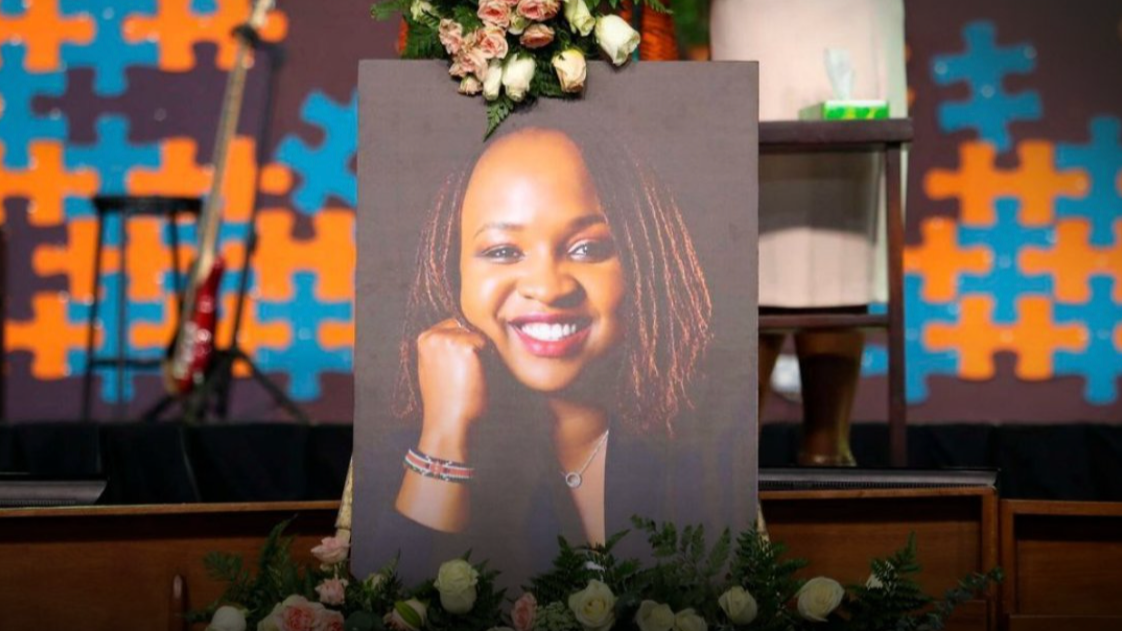
The final send-off of one of Kenya’s most prominent data protection professionals has taken an extraordinary turn.
Rosemary Chemutai Koech Kimwatu, the former KCB Bank Group Head of Data Protection, was buried at her family home in Chepseon, Kericho County, late Friday night, August 28, only hours after a Nairobi court issued orders stopping her burial without the involvement of her husband.
The burial brought to an abrupt end a week-long dispute that had drawn her husband, her parents and siblings, her employer and the courts into a deeply personal battle over where she should be buried and who had the right to make decisions about her final send-off.
On Saturday, mourners gathered at the Chepseon home for a memorial service celebrating the life and career of the 40-year-old lawyer and technology expert.

But the circumstances surrounding her burial have now become almost as significant as the tributes being paid to her.
The court order came on Friday
The dispute moved to the Milimani Commercial Magistrate’s Court after Rosemary’s husband, Kevin Migwe Kimwatu, filed an urgent application on August 26.
Kimwatu told the court that he had been sidelined from funeral arrangements despite being Rosemary’s husband and the father of their four children.
He wanted the court to recognise his involvement in decisions concerning her burial and asked for her remains to be taken to his ancestral home in Matasia, within Ngong Sub-County, Kajiado County.
His position was that Rosemary should be buried at the family home associated with their marriage rather than at her parents’ home in Chepseon, Kericho.
The dispute became urgent because preparations for Rosemary’s burial in Kericho were already underway.
On Friday, Senior Principal Magistrate Agnes Mwangi issued interim orders restraining the respondents, their relatives, agents and employees from proceeding with the burial without Kimwatu’s involvement.
The court also barred the removal and burial of Rosemary’s remains from Lee Funeral Home pending further proceedings.
The case is scheduled to return to court on Monday, August 31.
Then, despite the order, Rosemary was buried that same night.
Why did the family bury her at night?
The family has now explained its decision.
Speaking at Saturday’s memorial service, clan chairman Samwel Keter, who is also a relative of Rosemary, said the decision was heavily influenced by Kalenjin cultural practices.
He said family members had travelled to Nairobi to discuss the burial arrangements but ultimately concluded that the burial could not be delayed for several more days.
According to Keter, their cultural practices require a deceased person to be buried relatively soon after death, particularly after a post-mortem examination.
He also said the family needed to perform traditional cleansing rituals connected to the circumstances surrounding Rosemary’s death.
The family therefore proceeded with the burial at Chepseon late on Friday.
Keter said their traditions do not allow burials to take place during the day, which explains why the interment happened after dark.
The explanation gives a very different picture from the simple description of a family deliberately ignoring a court.
The family says it was attempting to balance the court dispute with obligations it regarded as culturally important and time-sensitive.
The legal consequences of that decision, however, will ultimately be for the court to consider when the case comes up on Monday.
Why did Rosemary’s husband go to court?
Kimwatu’s court papers reveal that his relationship with Rosemary had been complicated in the months before her death.
He acknowledged that the couple had been separated for approximately four months.
But he told the court that they had reconciled and that Rosemary had expressed an intention to return to their matrimonial home.
According to his account, she died before that could happen.
He therefore challenged what he described as efforts by Rosemary’s family to organise her burial without involving him.
He wanted her buried at Matasia in Kajiado County, where he said he had already made substantial preparations.
He also expressed concern that his children could effectively be excluded from their mother’s gravesite if she were buried far away from where he expected her to be laid to rest.
The family, meanwhile, wanted Rosemary buried at her parents’ home in Chepseon.
That disagreement eventually became a legal battle.
Then came the KCB letter
One of the most intriguing pieces of the dispute is a letter written by KCB to Lee Funeral Home.
The letter, dated August 25, identified two people in the bank’s employment records as Rosemary’s next of kin: her sister, Judy Koech-Oyamo, and her son, Charles Migwe Kimwatu.
KCB authorised the two to liaise with the funeral home concerning the release, collection and burial of Rosemary’s remains.
That revelation became particularly significant because her husband was not among the two people named in the bank’s employment records.
Kimwatu says he learnt of the arrangement when he went to Lee Funeral Home on August 26 to follow up on his wife’s funeral.
His lawyers subsequently challenged KCB’s involvement, arguing that an employer does not have the authority to determine who should control the funeral arrangements of a deceased employee.
But KCB’s letter also contained an important qualification.
The bank said the communication was strictly for funeral and mortuary purposes. It did not purport to determine who had legal authority over Rosemary’s estate, pension, insurance benefits, terminal dues or other assets.
Those matters, KCB said, would require the appropriate legal documentation, such as a grant of probate or letters of administration.
That distinction could become important as the dispute develops.
Being listed as a “next of kin” in an employer’s records does not necessarily settle every question concerning a deceased person’s estate or burial rights.
Who was Rosemary Koech?
Before the burial dispute thrust her family life into the headlines, Rosemary was best known for her work in law, technology and data protection.
She had built a career spanning nearly two decades and became a respected figure in Kenya’s technology, privacy and legal circles.
She joined KCB in 2022 after working at Safaricom, where she had served as a Public Policy Manager.
At KCB, she rose to become Head of Data Protection within the bank’s Risk Division.
Her work placed her at the centre of one of the most important issues facing modern businesses: how companies collect, use, store and protect people’s personal information.
She was also known in technology circles by the name TechWakili.
Colleagues and members of Kenya’s technology and legal communities have since described her as a pioneer in conversations surrounding privacy, digital rights and responsible use of data.
Her death therefore sent shockwaves well beyond her immediate family.
Her death came only days before the burial dispute
Rosemary died on August 21, 2026, at her home in the Ole Nairi area of Ngong, Kajiado County.
A post-mortem examination was subsequently conducted at Lee Funeral Home.
According to reporting based on the findings of Chief Government Pathologist Dr Johansen Oduor, the examination established suicide as the cause of death.
Police investigations into the circumstances surrounding her death have also been reported.
That finding should be distinguished from questions about what may have contributed to her death. The post-mortem establishes the medical cause, but it does not by itself establish the full circumstances surrounding a person’s state of mind or the pressures they may have experienced.
Those questions have generated considerable public discussion, particularly after reports emerged about difficulties in her personal life.
For that reason, claims circulating on social media about blame or responsibility should not be treated as established facts unless supported by evidence.
A family now caught between grief and litigation
The most striking feature of the dispute is that Rosemary’s family and her husband are not presenting themselves as strangers.
The family has insisted that it has no personal grudge against Kevin.
Speaking at Saturday’s memorial, Keter specifically said the family considers Kevin part of the family because he is the father of Rosemary’s children.
He said the fact that Rosemary was buried at her parents’ home should not be interpreted as a rejection of Kevin or the children.
The family believes she had a right to be buried on her parents’ land.
That is how the family says it arrived at the decision to use the Chepseon home as her final resting place.
But the legal dispute remains unresolved.
The court had ordered that the burial should not proceed without Kevin’s involvement and consent.
The family proceeded with the burial anyway.
What happens next is therefore likely to depend heavily on Monday’s court proceedings.
The children are now at the centre of another part of Rosemary’s legacy
Away from the dispute, there has also been an effort to ensure Rosemary’s four children are supported following her death.
The Kenya ICT Action Network (KICTANet), together with Rosemary’s family, has established the Rosemary Koech-Kimwatu Education Fund.
The fund was seeded with KSh1 million and is intended to support the children’s education while preserving her legacy.
That initiative has offered a different side to a week dominated by legal arguments and family disagreement.
For many of Rosemary’s colleagues, the woman being mourned is not primarily the subject of a burial dispute.
She is remembered as a lawyer, privacy expert, mentor and technology leader who helped shape Kenya’s emerging data protection landscape.
What happens now?
Rosemary is now buried at Chepseon.
The memorial service has taken place.
But the court case has not ended.
The parties are expected back before the Milimani court on Monday, August 31, when the circumstances surrounding the burial and the interim orders are expected to come under scrutiny.
The court will have to consider what effect the burial has on the dispute and how the parties’ competing claims should be handled going forward.
For the family, the immediate priority is likely to be mourning a daughter, sister and mother.
For Kevin Kimwatu, the legal fight over his wife’s final send-off is not necessarily over simply because the burial has taken place.
And for the public, the extraordinary events of the past few days have raised a difficult question that goes far beyond Rosemary’s case:
When a married person’s family and spouse disagree over where that person should be buried, who ultimately gets to decide?
That is now a question the Kenyan courts may have to answer once again.
For Rosemary’s four children, however, the legal arguments surrounding their mother’s burial are likely to matter far less than the loss itself.
They have now been left to grieve their mother while two sides of her family navigate a dispute that began in the days immediately following her death.
And as the court prepares to hear the matter again on Monday, the circumstances of Rosemary Koech Kimwatu’s final send-off remain far from settled.











RALEIGH, N.C. — A federal judge has revoked the U.S. citizenship of a 72-year-old Durham County man who admitted to making false statements during the naturalization process while concealing criminal conduct, federal authorities announced.
Cyril Domaquik Clemens, a native of Liberia, was sentenced to time served on September 17, 2026, after pleading guilty to naturalization fraud. The court also revoked his naturalized citizenship and ordered him to leave the United States at his own expense, according to the U.S. Department of Justice.
Federal prosecutors said Clemens made false statements under penalty of perjury on his citizenship application and during an interview with U.S. Citizenship and Immigration Services (USCIS).
According to prosecutors, Clemens answered “no” when asked whether he had ever forced or attempted to force someone into sexual contact or committed a crime for which he had not been arrested.
Clemens became a naturalized U.S. citizen in February 2021. Authorities said the criminal conduct at issue began before he applied for citizenship, meaning the information he withheld was relevant to his naturalization proceedings.
Clemens subsequently pleaded guilty to naturalization fraud in federal court in June 2026, acknowledging the false statements that formed the basis of the prosecution.
The federal case followed his earlier guilty plea in Durham County Superior Court in April 2023 to three counts of indecent liberties with a child. According to the Justice Department, the offenses occurred over an extended period, beginning before Clemens submitted his citizenship application.
The state criminal proceedings and the federal fraud case addressed separate offenses. The state case involved the child sex crimes, while the federal prosecution concerned the false statements made during the process of obtaining U.S. citizenship.
The federal judge revoked Clemens’ citizenship after the fraud conviction and ordered him to leave the country at his own expense. The order to depart is a separate consequence from the revocation of his citizenship. The available announcement does not establish whether he has completed his departure from the United States.
Federal law permits the government to seek denaturalization when citizenship was illegally obtained or secured through concealment of a material fact or willful misrepresentation. The legal requirements are outlined in Section 1451 of Title 8 of the U.S. Code.
The investigation involved U.S. Immigration and Customs Enforcement’s Enforcement and Removal Operations, Homeland Security Investigations, and U.S. Citizenship and Immigration Services. Authorities said the case was pursued as part of Operation False Haven, an initiative targeting immigration fraud involving individuals who allegedly concealed disqualifying criminal histories or other material information.
The case highlights the potential legal consequences of providing false information during the U.S. naturalization process, particularly when the concealed information concerns serious criminal conduct.
For additional details, readers can consult the U.S. Attorney’s Office for the Eastern District of North Carolina, which publishes federal prosecution announcements and information about cases handled in the district.
KSN Media Hub will continue to follow developments involving federal court rulings, immigration enforcement, and public safety.
This report is based on publicly available government announcements and legal information. Allegations and case details are attributed to prosecutors and official records.

A wedding ceremony was reportedly interrupted after a woman arrived at a church with her children and confronted a groom she claimed was still her husband.
The woman, who was carrying a baby on her back, reportedly approached the altar and called on her other children to stand beside her as she addressed the congregation.
The incident attracted attention online after footage circulated showing the confrontation unfolding in front of the bride, who was dressed in a white wedding gown, and other wedding attendees.
According to an account published by TUKO.co.ke on October 12, the woman claimed that she and the groom had neither divorced nor separated.
The video, attributed to Ripple Effects in the report, ended without revealing how the confrontation was resolved or whether the wedding eventually proceeded.
Woman says she received information about the wedding
According to the woman’s account as reported by TUKO.co.ke, the man had left home earlier that morning, telling her he was travelling upcountry.
She alleged that she later received information suggesting he was preparing to marry another woman.
The tip-off reportedly prompted her to go to the church, where she confronted the groom in front of the congregation.
During the exchange, she maintained that their relationship had not formally ended and called their children forward as she challenged the ceremony.
Her statements formed the centre of the confrontation, although the groom’s response and his account of the relationship were not included in the material available for this report.
Bride caught in an unexpected confrontation
The incident reportedly left the bride and other people attending the ceremony visibly surprised.
According to the description accompanying the footage, the bride remained near the altar as the woman addressed the congregation. The groom was also present during the exchange, while the priest and other church participants watched.
The available video did not establish whether the ceremony was suspended, cancelled or later continued.
It also did not provide independent confirmation of the woman’s marital status or clarify whether any legal proceedings had taken place before the planned wedding.
Similar incidents have been reported before
Church confrontations involving disputed relationships are not entirely new in news coverage.
In October 2014, The Standard reported a separate incident in Kariobangi South, Nairobi, in which a woman disrupted a church service while alleging that her husband had neglected her and their child.
The circumstances of that earlier incident were different, and there is no evidence linking it to the current video. It nevertheless illustrates how disputes over family responsibilities and relationships can sometimes become public during religious gatherings.
Read The Standard’s 2014 report.
Questions remain unanswered
The latest wedding incident has generated questions about the groom’s relationship with the woman, the bride’s knowledge of the alleged marriage and the eventual outcome of the ceremony.
However, the available footage and published account do not answer those questions conclusively.
KSNMediaHub.com could not establish an independent report confirming the identities of those involved, the location of the church or the legal status of the relationship.
The woman’s statements should therefore be understood as allegations rather than established findings. A response from the groom, the bride or other people directly involved could provide additional context.
News
Fred Machoka Breaks Silence Over Golden Jubilee Rhumba Concert Drama Involving His Niece, Gloria Owoba

Veteran Kenyan broadcaster Fred Machoka has expressed gratitude following his Golden Jubilee Rhumba concert, reflecting on the concerns that surrounded the event before it brought together celebrated musicians from Kenya and the Democratic Republic of Congo.
The landmark celebration attracted Rhumba enthusiasts eager to watch established performers, including Congolese music star Koffi Olomide, legendary singer Mbilia Bel, Them Mushrooms and Les Wanyika.
However, the concert also generated online discussion following separate incidents involving Koffi Olomide and former nominated senator Gloria Orwoba, drawing attention away from some of the evening’s musical highlights.
In a post-event message cited by TUKO.co.ke, Machoka opened up about the uncertainty the organising team faced before the concert, including concerns about weather conditions and fears that an Ebola-related scare might affect attendance.
Despite those worries, the veteran broadcaster expressed relief that the event went ahead as planned.
Fred Machoka reflects on concerns before the concert
Machoka said the organising team had been anxious about whether external circumstances would disrupt the celebrations, particularly the possibility of rain affecting the event.
He also recalled concerns about whether Ebola-related fears might discourage people from attending.
In his post, Machoka credited God for helping the organisers overcome their worries and deliver the celebration.
His remarks offered a glimpse into the pressures associated with organising a major live music event featuring internationally recognised performers and a large audience.
The broadcaster also thanked fans who turned up to support the concert, praising their enthusiasm and the reception given to the musicians.
Koffi Olomide delivers an extended performance
Koffi Olomide was among the evening’s headline performers, with Machoka praising the Congolese star for entertaining fans during an extended set.
According to the remarks quoted by TUKO.co.ke, Koffi performed for approximately two hours, while his wife, Cindy Le Cœur, and other musicians also contributed to the programme.
Mbilia Bel, Them Mushrooms and Les Wanyika were among the established acts associated with the concert, which celebrated the enduring popularity of Rhumba music across East Africa.
The event highlighted the genre’s continued appeal among audiences who appreciate its distinctive guitar arrangements, harmonies and dance rhythms.
Machoka also recognised the contribution of the event’s presenters and hosts, including Jeff Koinange, Mwalimu Churchill, Eric Latiff, Dee and Patrick Igunza.
He thanked those involved in making the programme possible and indicated that another edition could be considered in the future.
Gloria Orwoba incident draws attention
Despite the music performances, the event attracted controversy after former nominated senator Gloria Orwoba reportedly encountered a difficult moment on stage.
TUKO.co.ke reported that Orwoba was asked to leave the stage amid chants from some members of the audience.
The incident generated discussion online, with attention also directed at her relationship with Machoka, who is her uncle.
However, the circumstances surrounding the exchange and the motivations of individual audience members should not be assumed beyond what can be established from verified footage and accounts.
The episode added a political dimension to an event primarily organised to celebrate music and Machoka’s milestone.
Disagreement involving Koffi Olomide also discussed
A separate incident involving Machoka and Koffi Olomide also attracted attention after footage and accounts of an apparent disagreement circulated on social media.
The exchange became another talking point following the concert, prompting discussion about what had happened between the veteran broadcaster and the Congolese musician.
The available account does not, on its own, establish the full circumstances of the disagreement or either man’s complete perspective on the incident.
Further details should therefore be attributed to verified footage or direct statements from the individuals involved rather than speculation.
Machoka focuses on gratitude and the possibility of another concert
Despite the controversies, Machoka’s post-event message emphasised appreciation for the fans, musicians, presenters and other people who contributed to the celebration.
His remarks suggested that he regarded the event as an important milestone, notwithstanding the challenges and public discussion surrounding it.
He also left open the possibility of organising another edition, while acknowledging that a repeat event was not guaranteed.
The Golden Jubilee celebration brought together generations of Rhumba performers and audiences, underlining the genre’s lasting place in Kenya’s entertainment scene.
For Machoka, the response from music lovers appeared to be a central part of the experience, even as the incidents involving Orwoba and Koffi continued to generate debate after the final performances.

Federal Judge Revokes Citizenship of North Carolina Man Convicted of Child Sex Crimes

Woman Interrupts Church Wedding With Children, Claims Groom Is Her Husband

Fred Machoka Breaks Silence Over Golden Jubilee Rhumba Concert Drama Involving His Niece, Gloria Owoba

VIDEO: iPhone 17 Air Leak Reveals Ultra-Thin Design: A Bold Leap Beyond the iPhone 16 Pro

How U.S. Remittance 5% Tax Bill Could Impact Kenyan Diaspora: What You Need to Know

Motorola Launches $1,300 Razr Ultra Foldable Smartphone with AI Features, Swarovski-Enhanced Earbuds

 Tech1 year ago
VIDEO: iPhone 17 Air Leak Reveals Ultra-Thin Design: A Bold Leap Beyond the iPhone 16 Pro
- News1 year ago
How U.S. Remittance 5% Tax Bill Could Impact Kenyan Diaspora: What You Need to Know
- Tech1 year ago
Motorola Launches $1,300 Razr Ultra Foldable Smartphone with AI Features, Swarovski-Enhanced Earbuds
- Insurance Basics1 year ago
Popular Apps May Be Secretly Tracking Your Driving – And Raising Your Insurance Rates
- Tech1 year ago
Motorola Razr Ultra (2025) Launches With Free 1TB Storage Upgrade
- News1 year ago
What would you do if your Gold Digger girlfriend behaved like this?
- News1 year ago
Box Office: ‘Sinners’ Holds No. 1 Spot With $13M Friday; ‘The Accountant 2’ Debuts With $9.4M
- Insurance Basics1 year ago
Florida House Passes ‘Pam Rock Act’ Requiring Dog Registry and $100K Liability Insurance